Mostrando las entradas con la etiqueta history. Mostrar todas las entradas
Mostrando las entradas con la etiqueta history. Mostrar todas las entradas
lunes, 10 de julio de 2017

miércoles, 5 de julio de 2017
Potsdam and relations between the West and the USSR
A. What was decided at the Potsdam conference?
The allied leaders arranged for July 1945 in the Berlin suburb of Potsdam, a conference. There weren’t taken any decision, due to the fact the distrust between Stalin and Truman, so they had different disagreements, over what to do with Germany, over reparations and also over Soviet policy in Eastern Europe.
B. Why did the wartime unity of the Allies break down between 1945 and 1947?
The wartime unity of the Allies broke down because there was tension and suspicion between the USA’s president, Truman, and the USSR leader, Stalin. Because of these, in the Potsdam Conference, they did not come to an agreement in some major aspects: what to do with Germany, reparations and Soviet policy in eastern Europe.
Furthermore, in the months after the Potsdam Conference Stalin achieved the control of eastern Europe. Poland, Hungary, Romania Bulgaria and Albania had all Communist governments that were loyal to Stalin. Churchill described the borders between them and the West as an “iron curtain”. With Communist governments in all eastern Europe, Stalin tightened his control, eliminating opposition. In 1947, he set up the Cominform to organize and control all the Communist Parties, replacing independent leaders with people who were loyal to him.
C. "The Truman Doctrine generated much more tension than the Berlin Blockade" How far is that statement true?
Different things increased the Cold War tension, such as the Truman Doctrine: giving money to countries that were going to turn into Communism, to stop that movement. Or the Berlin Blockade, with USSR taking control of Germany. But what event produced more tension?
On the one hand, the Truman Doctrine added tension to the Cold War because USA was sending equipment and advice to any country which was, in the American view, threatened by a Communist takeover. They did this as a way of containing Communism.
On the other hand, the Berlin Blockade added much more tension to the Cold War, because as people living in the Soviet zone wanted to leave that zone, and Stalin, who had the control of Germany´s capital, closed all the railways and any possible way of going away from that zone, and that hurted a lot of countries and people.
To conclude, I think the Berlin Blockade added more tension to the Cold War that the Truman Doctrine because that involved more countries.
The allied leaders arranged for July 1945 in the Berlin suburb of Potsdam, a conference. There weren’t taken any decision, due to the fact the distrust between Stalin and Truman, so they had different disagreements, over what to do with Germany, over reparations and also over Soviet policy in Eastern Europe.
B. Why did the wartime unity of the Allies break down between 1945 and 1947?
The wartime unity of the Allies broke down because there was tension and suspicion between the USA’s president, Truman, and the USSR leader, Stalin. Because of these, in the Potsdam Conference, they did not come to an agreement in some major aspects: what to do with Germany, reparations and Soviet policy in eastern Europe.
Furthermore, in the months after the Potsdam Conference Stalin achieved the control of eastern Europe. Poland, Hungary, Romania Bulgaria and Albania had all Communist governments that were loyal to Stalin. Churchill described the borders between them and the West as an “iron curtain”. With Communist governments in all eastern Europe, Stalin tightened his control, eliminating opposition. In 1947, he set up the Cominform to organize and control all the Communist Parties, replacing independent leaders with people who were loyal to him.
C. "The Truman Doctrine generated much more tension than the Berlin Blockade" How far is that statement true?
Different things increased the Cold War tension, such as the Truman Doctrine: giving money to countries that were going to turn into Communism, to stop that movement. Or the Berlin Blockade, with USSR taking control of Germany. But what event produced more tension?
On the one hand, the Truman Doctrine added tension to the Cold War because USA was sending equipment and advice to any country which was, in the American view, threatened by a Communist takeover. They did this as a way of containing Communism.
On the other hand, the Berlin Blockade added much more tension to the Cold War, because as people living in the Soviet zone wanted to leave that zone, and Stalin, who had the control of Germany´s capital, closed all the railways and any possible way of going away from that zone, and that hurted a lot of countries and people.
To conclude, I think the Berlin Blockade added more tension to the Cold War that the Truman Doctrine because that involved more countries.
Vietnam War
1. Describe American involvement in South Vietnam between 1854 and 1963
In 1954 the US applied a different rule: it prevented elections from taking place because it feared that the Communists would win. The Americans thought that China and the USSR were planning to spread Communism, and if Vietnam fell, many other countries (Laos, Thailand, etc.) would fall with it, and Americans were determined to resist the spread. In 1955, US helped the extremely corrupt president of South Vietnam, Ngo Dinh Diem, to set up the Republic of South Vietnam (set up in December 1960), as he was anti-Communist and prepared to exile Communists. By 1962, President Kennedy was sending military personnel to fight the Viet Cong, arms and soldiers that were called “Advisers”. In 1963 and 1964, tension between North and South Vietnam increased and so did American involvement. However, Kennedy said he was determined that the US would not “blunder into war, unclear about aims or how to get out again”. On March 1965, America was at war in Vietnam.
2. Why was Cuba important to the USA?
Cuba was important to Usa since they were allies and negotiate together. Also Usa owned most of the businesses of Cuba and they had a huge naval base in the Cuba Island. Between 1959-61 Castro took over all this business and he wanted to run Cuba without interference, so Usa broke of diplomatic relations with Cuba. The invasion of USA in the Island suggest that the USA was unwilling to get directly involved in Cuba. The soviet leader, Krushchev was scroful of Kennedy’s pathetic attempt to remove Communism from Cuba. Soviets was helping Cuba and Americans watched all this with great alarm, so Kennedy asked himself what he could do (Invade, Do nothing, Surgial Air Attack, Blockade, Diplomatic pressures).
3. How far is it true that the USA left the Vietnam War because of military failure?
The US was involved in the Vietnam War from 1954 to 1973, when they retired all of their forces from the country. Many historians claim that this was due to military failure, but, how far is that true?
To begin with, the war was very different from how the Americans had imagined it. They thought their soldiers would win it easily, as they had largely superior technology and firepower, but the guerrilla tactics implemented by the Viet Cong fighters made this practically impossible. There were also other incidents, as the My Lay massacre and the Tet Offensive, that undermined the USA’s involvement in Vietnam. After the Tet offensive, President Johnson came to the conclusion that the war could not be won militarily.
There were also other factors that contributed to the end of the American involvement in Vietnam. A very important one of them were the huge peace demonstrations in universities and public spaces, in which people complained about the war in Vietnam. These were mainly because the USA was not only spending enormous amounts of money in the war, but also because they were sending hundreds of thousands of young men to fight a war that was not theirs. Moreover, many people were horrified when the My Lai massacre came to light. President Nixon (the one who pulled the USA out of Vietnam) was also involved in the Watergate Scandal.
In conclusion, military failure was an important cause for ending the USA involvement in Vietnam war, but there were also other reasons that made this happen.
4. Why did the unity of allies break down by 1945 and 1947?
The unit of allies between USA and USSR break down by 1945 and 1947, because they had different thoughts and wanted different things, Truman didn’t trust Stalin. Stalin was not respecting the agreement.
sábado, 27 de mayo de 2017
The presidential election in 1932
The Republicans won the presidential election
in 1928 when the economy was still booming. Their candidate was Herbert Hoover.
One year later, the Wall Street Crash happened and brought severe consequences
for the USA’s industry and people. In the next presidential election, in 1932
(the first one after the Wall Street Crash), Hoover lost to the Democrat
candidate, Franklin D Roosevelt. Many people state that this was mainly because
of the Republican policies and their reaction to the Crash, but, how far is
that true?
 |
| Herbert Hoover |
To begin with, the Republican policies are
four: Laissez faire (not interceding with people´s economy), tariffs for
importation (they protected US industry against foreign competition), low
taxation (they thought people would buy goods or invest in industry with that
money) and trusts (huge corporations that dominated industry). Republicans
wouldn´t change their basic policies, mostly because they believed that the
Depression was caused by economic problems in Europe, not by failures in the US
economy. They thought that business could solve its problems alone and that
help from the Government was no needed. Moreover, they claimed that business
consisted on a cycle of boom and bust, so prosperity would come back alone. It
was because of the policy of Laissez-faire that Hoover did almost nothing to
help people who were hit hardest for the depression, as he thought that social
security and relief were a responsibility and should be provided by local
governments. He faced bitter criticism because of that.
 |
| Franklin D Roosevelt |
Nevertheless, there were other causes for
Roosevelt’s success in the presidential election, which were Hoover’s flaws and
Roosevelt’s characteristics as a politician. As regard Hoover’s flaws, he was
known as a “do nothing” president, even though he tried to do something, but
that was not enough. He tried to restart the economy by cutting taxes and to
persuade business leaders not to cut wages. Moreover, he set up the
Reconstruction Finance Company to prevent banks from going bankrupts. He also
tried to protect the US industry by tariffs, but this made the Depression
worse. In connection to Roosevelts characteristics as a politician, he believed
in an active government to improve people´s lives. He wanted to spend public
many to create jobs (he already did this as Governor of New York), and asked
for advise to experts (factory owners, economists and union leaders). He didn’t
have a specific plan, but he realized that people wanted action and he gave
them that.
To conclude, even though the Republican’s
reaction against the Crash had to do with Roosevelt winning the election in
1932, Hoover’s flaws and Roosevelt’s characteristics were also very important. This
was so because Hoover’s flaws exposed him to great criticism and turned public
opinion against him, while Roosevelt gave people what they wanted.
domingo, 21 de mayo de 2017
Reasons for the economic growth
There was a
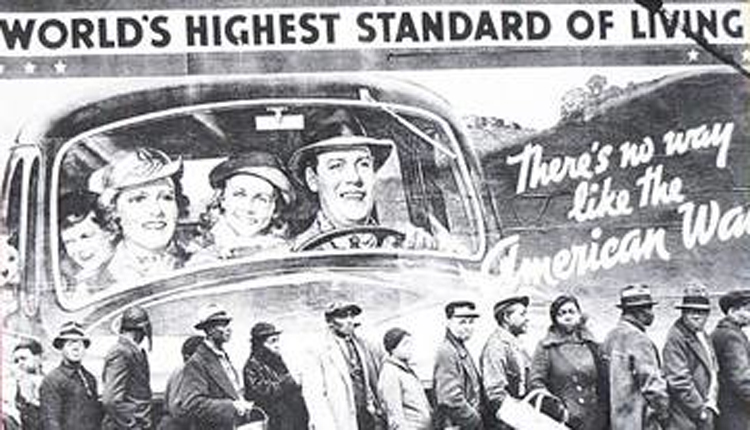
great economic growth in the USA in the 1920s, which led to the “Boom” and the
“Roaring Twenties”. Between its many reasons, there were hire purchase, that
consisted on buying the good at the moment but paying it later on instalments,
set by the seller; and credits, that were loans given by banks to consumers, so
they could buy products. How important were hire purchase and credits among
others causes for the economic growth?
 There is
many people who firmly believes that they were the two main causes for the
boom. To begin with, the Boom was a consumer-led boom, so the industries needed
people to buy their products. Credits and hire purchase had an important part
on making this happen, as they made possible for people such as factory workers
and farmers to be able to afford to buy goods, such as cars, refrigerators,
vacuum cleaners, radios, etc., as banks would lend people or small companies if
they needed so, and most shops and companies used the hire purchase scheme.
Moreover, hire purchase was used by many firms, such as the motor car industry,
revolutionized by Henry Ford, due to the fact that the number of sales
increased because of it and it was an easy way of making people buy what they
produced. Credits allowed many speculators to invest on companies, what caused
a rise in their shares’ prices, as there was more demand than offer. It was
possible for them to buy shares because they bought them on the margin, what
meant that they only paid for 10% of the total value. Most of speculators got
the money to pay for shares by borrowing it (mainly from bank credits), and
payed back when they had already sold the share and recovered money. Most
people saw the share stock market as a quick way of getting rich, and many new
millionaires flourished from that market indeed.
There is
many people who firmly believes that they were the two main causes for the
boom. To begin with, the Boom was a consumer-led boom, so the industries needed
people to buy their products. Credits and hire purchase had an important part
on making this happen, as they made possible for people such as factory workers
and farmers to be able to afford to buy goods, such as cars, refrigerators,
vacuum cleaners, radios, etc., as banks would lend people or small companies if
they needed so, and most shops and companies used the hire purchase scheme.
Moreover, hire purchase was used by many firms, such as the motor car industry,
revolutionized by Henry Ford, due to the fact that the number of sales
increased because of it and it was an easy way of making people buy what they
produced. Credits allowed many speculators to invest on companies, what caused
a rise in their shares’ prices, as there was more demand than offer. It was
possible for them to buy shares because they bought them on the margin, what
meant that they only paid for 10% of the total value. Most of speculators got
the money to pay for shares by borrowing it (mainly from bank credits), and
payed back when they had already sold the share and recovered money. Most
people saw the share stock market as a quick way of getting rich, and many new
millionaires flourished from that market indeed.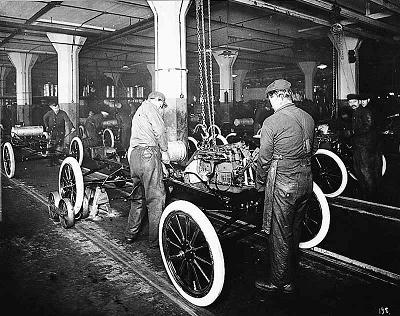
On the other hand, some
people believe hire purchase and credit were not major reasons for the economic
growth. Even though they
were very important reasons, there were other causes. One of the main causes
was the USA’s industrial strength. The country’s industry was successful
because they had the raw materials they needed within its borders and did no
needed to import anything, added to the fact that electricity made everything
easier, allowing factories to produce goods (the new household consumer goods
as vacuum cleaners and radios) faster and in higher quantities. Besides, they
were able to produce everything they needed for their population`s consumption,
and exported their surpluses to other countries. Moreover, other main cause for
the economic growth was the development of new methods of production, as
Fordism, the use of new technologies and the Republican Policies
(Laissez-faire, tariffs for importation, low taxation and the development of
trusts). Another thing that boosted goods sales were the mass-marketing and
advertising strategies used: the advertisers who campaigned to encourage people
to join the army in the WWI now worked with companies to sell their products. Furthermore, some people believe the First World War had great influence in the economic boom, since it allowed the USA to sell arms and food to the allies and this one-way trade gave the American industry a great income. Moreover, after the First World War the USA became a world leader in several sectors of industry, such as the chemical industry which had been led by Germany before the world ruined the country.
The way I see things, despite the fact that credits and hire purchase were indeed two major causes for the economic growth in the USA in the 1920s, this would not have been possible without the other reasons, such as advertising, the country’s industrial strength and the influence of the First World War.
The way I see things, despite the fact that credits and hire purchase were indeed two major causes for the economic growth in the USA in the 1920s, this would not have been possible without the other reasons, such as advertising, the country’s industrial strength and the influence of the First World War.
jueves, 16 de abril de 2015
viernes, 20 de marzo de 2015
Suscribirse a:
Entradas (Atom)